
You open a beat store, hear something that fits your sound, then look at the prices and freeze. One beat is $25. The one next to it is $500. They sound similar. So what gives, and how much are you actually supposed to spend?
This is one of the most common questions independent artists ask, and the honest answer is that it depends on what you’re releasing, not just the beat itself. A freestyle for your story doesn’t need the same license as a single you’re pitching to playlists. This guide breaks down what rap beats really cost in 2026, why prices swing so hard, and how to spend the right amount for where you are in your career.
In 2026, a basic rap beat lease costs around $20 to $30, a premium WAV lease about $50, and a trackout lease near $100. Exclusive rights typically run $300 to $500 with established producers, though some start lower. The right price depends on your release goal, not the beat alone.
What determines a rap beat’s price? A beat’s price is set by the license type (lease vs. exclusive), the files included (MP3, WAV, or trackout stems), the usage rights and stream caps, and the producer’s reputation and demand. The same instrumental can sell as a cheap lease to many artists or as one high-priced exclusive to a single buyer.
Key Takeaways
- Basic leases run about $20 to $30, premium WAV leases around $50, and trackout leases near $100 in 2026.
- Exclusive rights commonly cost $300 to $500 with established producers, sometimes more for in-demand names.
- You’re not paying for the audio alone, you’re paying for the rights, the file quality, and the stream caps attached.
- The producer usually keeps about 50 percent of publishing even on a lease, which is standard and built into the price.
- The smartest spend matches the license tier to your actual release goal, not to the most expensive option.
- JBZ Beats keeps Exclusive Beats for Sale at $99 to $199, well below the $300 to $500 industry norm, with free mixing and mastering on every purchase.
Why “How Much” Is the Wrong First Question
Most artists ask “how much is this beat” before they’ve asked “what am I doing with it.” That’s backward, and it’s how people end up overpaying for a freestyle or underpaying for a single that takes off.
Here’s the thing. Price and purpose are tied together. A $25 lease is a great deal for a loosie you’re dropping on social media. That same $25 lease is a bad deal if you’re putting the track on an album you plan to pitch to a label, because the stream caps and shared-use risk can bite you later.
So before you look at a single number, get clear on the release. Is this a throwaway freestyle, a single you’ll promote hard, or a project you want to own outright? Once you know that, the right price almost picks itself. We’ll map each scenario to a tier further down.
The market is wide because the use cases are wide. When you buy rap beats, you’re really buying a set of rights sized to a goal. Match the two and you never overpay.
Read More About: Exclusive vs Non-Exclusive Beat Licenses Explained for 2026
What Rap Beats Actually Cost in 2026
Let’s get to the numbers. Based on current marketplace data from platforms like BeatStars and Airbit, plus independent producer stores, here’s what Rap Beats for Sale typically cost in 2026 by license type.
| License Type | What You Get | Typical 2026 Price |
| Basic lease (MP3) | Tagged or untagged MP3, low stream cap | $20 – $30 |
| Premium lease (WAV) | Higher-quality WAV, larger caps | ~$50 |
| Trackout lease (stems) | WAV plus individual stems | ~$100 |
| Unlimited lease | Stems, no stream or unit caps | $70 – $299 |
| Exclusive rights | Beat removed from sale, sole use | $99 – $500+ |
| Custom exclusive | Made for you from scratch | $300 – $1,000+ |
A few patterns are worth knowing. The single most popular lease price across the market is $50 for the premium WAV tier. That’s not because $50 is magically “correct,” it’s the point where value and price friction meet for most buyers. Basic MP3 leases cluster around $25, and trackout leases land near $100.
Exclusives are where prices spread out the most. A newer producer might sell an exclusive for $300, while a top-tier name can charge $5,000 or more for the same kind of rights. The common industry standard sits around $300 to $500 for a quality catalog exclusive. That’s the range to keep in your head as a sanity check.
|
Browse Rap Beats for Sale at JBZ Beats Leases, unlimited licenses, and exclusive rights with clear pricing and no hidden fees. Free mixing and mastering with every purchase.
|
Why the Same Beat Can Cost $25 or $500
It confuses a lot of artists. How can one instrumental be $25 in one spot and $500 in another? The audio didn’t change. The rights did.
Here’s what actually moves the price:
- License type. A lease rents you access while the producer keeps selling it. An exclusive removes the beat from sale for everyone else. Permanence costs more.
- Files included. An MP3 is cheap. A WAV sounds better. Trackout stems let an engineer mix each element separately, so they cost the most.
- Usage rights and caps. A basic lease may cap you at 50,000 streams or 5,000 units. Unlimited and exclusive licenses lift those caps, and that freedom is priced in.
- Producer demand and reputation. A producer with placements and a big audience charges more because their beats carry proven value and scarcity.
- Exclusivity math. When a producer sells an exclusive, they give up all future lease income on that beat. The exclusive price has to cover that loss, which is why it can be ten or twenty times a single lease.
Once you see price as a measure of rights rather than sound quality, the spread stops looking random. You’re paying for what you’re allowed to do, not just what you hear.
Read More About: Music Licensing Guide for Beat Makers
What You’re Really Paying For at Each Tier
Each tier solves a different problem. Knowing which problem you have keeps you from buying too much or too little.
Basic lease (~$25)
Good for freestyles, demos, and early social posts. You get an MP3 and a low stream cap. It’s the entry point for testing your sound. The catch is the cap and the shared use, since the same beat goes to other artists too.
Premium WAV lease (~$50)
The most popular tier for a reason. Better audio than an MP3 and roomier caps, which suits singles for new artists who are starting to promote but aren’t ready to pay for exclusivity.
Trackout lease (~$100)
This is the one serious artists underrate. Trackout stems give your engineer the separated kick, snare, melody, and bass, which is the foundation of a clean professional mix. If you care about how the final record sounds, stems matter.
Unlimited lease ($70 – $299)
No stream or unit caps. This is the sweet spot for independent artists actively pushing a release without the budget for a full exclusive. It removes the compliance risk of basic leases.
Exclusive rights ($99 – $500+)
The beat comes off the market and is yours alone. No competing artists on the same instrumental, no content ID conflicts, and a clean chain of title for label deals and sync placements. For artists hunting a single they believe in, Cheap Exclusive Beats from a quality store can be the best value in the whole market.
|
Want the Beat to Yourself? Exclusive Beats for Sale at JBZ Beats Catalog exclusives start at $99 with full stems and unlimited commercial use, plus free mixing and mastering. No conflicts, no competing artists on your instrumental. |
How Much Should You Pay? Match the Price to the Goal
Forget the sticker for a second. The right number is whatever fits the release. Here’s the simple map.
| Your Release | License to Buy | Realistic Spend |
| Freestyle or social loosie | Basic lease | $20 – $30 |
| First single, light promo | Premium WAV lease | ~$50 |
| Single you’re promoting seriously | Unlimited lease or trackout | $99 – $199 |
| Album or label-pitch track | Exclusive | $99 – $500 |
| Signature or brand-anthem track | Exclusive or custom | $99 – $1,000+ |
Notice the pattern. As the stakes rise, you buy more rights, not just better audio. A track with genuine breakout potential is worth an exclusive, because the content ID and competition risks of a shared lease aren’t worth taking on something you’re betting your year on.
For everything low-stakes, a lease is the smart, budget-conscious call. There’s no prize for overpaying on a freestyle.
Hidden Costs Most Artists Forget
The beat price is only part of the math. A finished, release-ready song has a few more line items, and skipping them is why some cheap releases sound cheap.
Here’s what catches people out:
- Mixing and mastering. Even a great beat and a great verse fall flat with a weak mix. Paying a beat price and then releasing an unmastered track wastes the investment.
- Recording gear, if you track at home. Your monitoring setup decides whether your vocals translate. A solid best audio interface gives you clean preamps and low latency. Honest speakers matter even more, and there are strong options among the best studio monitors under 1000 that handle the low end where rap mixes usually break. If monitors aren’t realistic, the best open-back headphones under 200 give you accurate detail for catching breaths and sibilance.
- Multiple beats for a project. An album of 10 to 15 songs on unlimited leases at $70 to $299 each adds up fast. This is where bundles and exclusives with free services change your total cost.
Here’s the shortcut that saves the most money. The best studio monitors for mixing won’t help if you don’t have time to learn mixing, and a bad master is permanent once your song is live. That’s why every purchase at JBZ Beats includes free professional mixing and mastering on your finished track. You buy the beat, record clean vocals, and get back a release-ready file, no extra gear or mixing fees required.
How to Spend Smart Without Overpaying
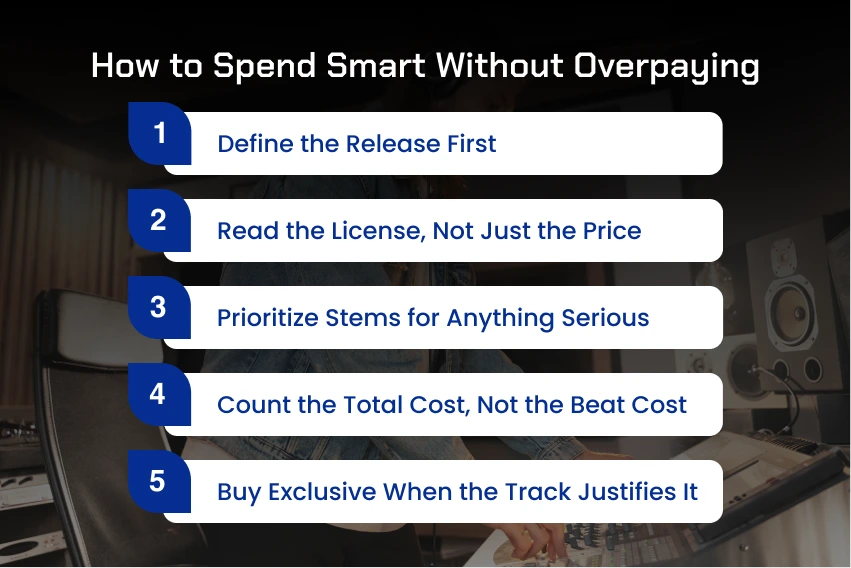
Follow these five steps and you’ll never overpay or under-buy again.
Step 1: Define the Release First
Decide what the track is before you shop. Freestyle, promoted single, or label project. The answer sets your tier and your budget in one move.
Step 2: Read the License, Not Just the Price
A $25 lease with a tiny stream cap can cost more than a $99 unlimited license once your song grows. Check stream caps, unit caps, permitted uses, and the royalty split before you pay. If a store hides its license, don’t buy from it.
Step 3: Prioritize Stems for Anything Serious
Trackout stems are essential for a real mix. If a beat you plan to promote doesn’t include stems in the lease, factor in upgrading. When you buy Hip Hop Beats for a single that matters, stems aren’t optional.
Step 4: Count the Total Cost, Not the Beat Cost
Add mixing, mastering, and any gear to the beat price. A “cheap” beat with $150 of mixing on top isn’t cheap. A fairly priced beat with free mixing and mastering often wins on total cost.
Step 5: Buy Exclusive When the Track Justifies It
If you believe in the song, an exclusive removes competition and protects your release. Paying $99 to $199 up front beats untangling a stream cap or a content ID conflict when your single is climbing.
|
Need a Beat First? Buy Rap Beats Online at JBZ Beats Hip Hop Beats for Sale and Instrumentals for Sale with instant downloads, clear licensing, and free mixing and mastering on every purchase.
|
What a Fair Price Looks Like at JBZ Beats
Most artists are budget-conscious, and that’s exactly who JBZ Beats is built for. The pricing is designed to give independent artists professional results without the industry markup.
Here’s how it lines up against the market:
- Unlimited leases at $99 with MP3, WAV, and trackout stems, plus unlimited units and streams. That removes the cap risk of basic leases.
- Catalog exclusives at $99 to $199, well under the $300 to $500 standard many producers charge for comparable quality.
- Custom exclusive beats from $499, produced from scratch for your project.
- Free professional mixing and mastering on every purchase, which is a cost most stores leave entirely on you.
The point isn’t to be the cheapest. It’s to be fair, transparent, and complete, so your money goes toward a finished record rather than a stack of add-on fees. When you browse Rap Instrumentals for Sale here, the price you see is the price that gets you release-ready.
Conclusion
Rap beat prices in 2026 aren’t one number, they’re a spectrum tied to rights. Basic leases sit around $25, premium WAV leases near $50, trackouts near $100, and exclusives commonly $300 to $500 with established producers. What you should pay depends on what you’re releasing, not on the beat alone.
This matters because the wrong tier costs you twice: once when you overpay for a low-stakes track, and again when you under-buy for a single that takes off and runs into stream caps or shared-use conflicts. Match the license to the goal and that problem disappears.
Ready to spend smart? Decide what your next track is, pick the tier that fits, and choose a store that bundles the real costs in. Browse Rap Beats for Sale at JBZ Beats, where exclusives start at $99 and mixing and mastering come free with every purchase.
FAQ
How much does a rap beat cost in 2026?
In 2026, a basic MP3 lease costs about $20 to $30, a premium WAV lease around $50, and a trackout lease near $100. Unlimited leases run $70 to $299, and exclusive rights typically cost $300 to $500 with established producers, though some catalog exclusives start lower. The price reflects the license and files, not just the audio.
Why are exclusive beats so much more expensive than leases?
Exclusive beats cost more because the producer removes the beat from sale permanently and gives up all future lease income from it. You also get the highest-quality files and sole use, which eliminates competing artists and content ID conflicts. The exclusive price covers the producer’s lost lease revenue, which is why it can be many times a single lease price.
Is it worth paying for an exclusive beat as a new artist?
It depends on the track. For freestyles and early demos, a lease is the budget-smart choice. For a single you truly believe in or a project you’re pitching to a label, an exclusive is worth it because it protects your release from stream caps and shared-use conflicts. Cheap exclusive beats from a quality store can be the best value for serious singles.
What’s the difference between a lease and a trackout?
A standard lease usually gives you a single mixed MP3 or WAV file, while a trackout lease includes the individual stems: separated kick, snare, melody, bass, and more. Trackouts cost more, around $100, because they let your engineer mix each element for a cleaner, more professional result. For any track you plan to promote, trackout stems are strongly recommended.
Do I still owe the producer money after I buy the beat?
Not usually as a direct payment, but the producer typically keeps about 50 percent of the composition (publishing) royalties even on a leased or exclusive beat, unless your contract includes a publishing buyout. You generally keep your master recording royalties. This split is standard and already built into the beat’s price, so there’s no surprise fee later.
How much should I budget for beats for a full project?
For a 10 to 15 song project, beats alone on unlimited leases at $70 to $299 each can total $300 to $600 or more. To control cost, look at bundles, exclusives with free services, or stores that include mixing and mastering. At JBZ Beats, unlimited leases at $99 and exclusives from $99 to $199 with free mixing and mastering keep a full project affordable.

