
Most artists treat the upload button as the start of a release, then get blindsided when their track gets held by a platform, flagged for a licensing conflict, or quietly leaves royalties uncollected for months. The truth is that a clean release is decided long before launch day, in the license you bought and the accounts you set up. This guide walks through the full process of releasing a song built on a beat you bought, from confirming your rights to distribution, royalty splits, and crediting your producer correctly.
Key Takeaways
- Your beat license, not the streaming platform, decides whether you can release commercially, so read it first
- You need a music distributor like DistroKid, TuneCore, or CD Baby because platforms do not accept direct uploads from individual artists
- The producer usually keeps the composition rights, which means they collect a publishing share even after you buy the beat
- Register with a PRO (ASCAP, BMI, or SESAC) and the MLC so you collect every royalty type your release earns
- Clean metadata and correct producer credit prevent the takedowns and payment holds that catch new artists
- Exclusive Beats for Sale at JBZ Beats start at $99, and every purchase includes free mixing and mastering, so your track is release-ready faster
Your Release Starts With the License, Not the Upload Button
The beat is the foundation. Your recording is the house you build on it. The release is opening the doors to the public. If the foundation has a crack, like a lease that caps your streams or a beat already sold to ten other artists, you find out at the worst possible time, usually after your song is live and gaining traction.
Competition makes this matter more than ever. Independent distribution data shows that roughly 106,000 new tracks reach digital platforms every single day. A good song is not enough on its own. You need a correctly licensed, properly credited release that will not trip an automated filter on Spotify, Apple Music, or YouTube.
That is the whole point of getting the boring parts right once. After that, you can release with confidence every time. When you buy rap beats with clear terms from the start, most of this work is already done for you at checkout.
Read More About: Exclusive vs Non-Exclusive Beat Licenses Explained for 2026
Does My Beat License Actually Let Me Release Commercially?
Before anything else, pull up the license agreement that came with your beat. Every reputable store sends one. If yours did not, that is a red flag for the store, not for you.
Read it with these questions in mind. Does the license allow paid distribution and monetization, or is it for demo use only? What is the stream and unit cap? Basic leases often cap you around 50,000 streams or 5,000 units, and crossing that line puts you out of compliance. Did you receive a high-quality WAV and trackout stems, or only an MP3? And what is the exact producer credit the license requires?
If you bought an exclusive license, you have the widest runway. No stream caps, no competing artists on the same instrumental, and a clean chain of title for label deals or sync placements later. If you are sitting on a basic lease and you believe the track has real potential, this is the moment to upgrade before you release, not after. This is exactly why some artists go straight for Cheap Exclusive Beats when they know a song matters, because paying a little more up front beats untangling a stream-cap problem when your single is climbing.
What Do I Need to Record and Mix Before I Release?
A streaming platform does not care how hard your bars are if the mix is muddy. Listeners decide in seconds, and a weak mix is one of the fastest ways to lose them. Before you release, your song needs to translate on phone speakers, earbuds, and car systems alike.
If you record at home, your monitoring setup matters more than your microphone, because you cannot fix what you cannot hear. A reliable audio interface is the bridge between your mic and your computer, so when you research the best audio interface for vocals, prioritize clean preamps and low latency over channels you will never use. Honest speakers matter even more, and the best studio monitors for mixing tell you the truth about your low end, which is where rap mixes usually fall apart. You do not need to overspend either, since there are strong picks among the best studio monitors under 1000 that will serve you for years. When monitors are not realistic, the best open-back headphones under 200 give you a wide, accurate image for catching breaths, sibilance, and timing.
Here is the honest shortcut, though. Most independent artists should not try to master their own first releases, because the learning curve is steep and a bad master is permanent once your song is live. That is why every purchase at JBZ Beats includes free professional mixing and mastering on your finished track. You record clean vocals, send them over, and get back a release-ready file, with no extra gear or mixing fees required.
Read More About: Music Licensing Guide for Beat Makers
How Do I Get My Song on Spotify and Apple Music?
You cannot upload directly to Spotify or Apple Music. They do not accept music from individual artists. You need a music distributor, which delivers your finished song to every platform from a single upload.
The main options work in two pricing models. DistroKid and Ditto charge a flat annual fee and let you keep 100 percent of your master royalties, which suits artists who release often. CD Baby uses a one-time per-release fee and keeps a small cut, around 9 percent, which can be cheaper for artists who release once or twice a year. TuneCore offers per-release pricing with publishing add-ons. Spotify’s algorithm does not favor any distributor, so ignore anyone promising an “algorithm boost.”
Pick based on how often you plan to release, set up your distributor account before launch day, and you remove the single most common cause of a delayed drop.
How Are Streaming Royalties Split When You Used a Bought Beat?
This is where independent artists have the least understanding and the most money at stake. When you release a song built on a licensed beat, the streaming income splits into two separate streams, and the producer has a stake in one of them even after you paid for the beat.
Every stream generates a master royalty, which pays for your recorded version and is collected by your distributor, and a composition royalty, which pays for the underlying musical work and is collected by your PRO and the MLC. On Spotify, industry analysis puts roughly 53 to 55 percent of the payout toward the master and about 17 percent toward the composition. The producer’s underlying composition rights typically entitle them to a share of that publishing side, usually as a credited co-writer, unless your exclusive agreement specifically includes a publishing buyout. Most beat licenses do not, so read yours.
|
Get Exclusive Rights Starting at $99 – JBZ Beats offers catalog Exclusive Beats for Sale with full stems and unlimited commercial use, plus free mixing and mastering. No conflicts, no competing artists on your instrumental. |
How Do I Credit the Producer the Right Way?
Producer credit is not a courtesy. It is almost always a contract requirement, and getting it right protects both your release and your relationship with the producer.
Most licenses ask you to credit the producer in two places: in the song title or subtitle, often as “Prod. by 231-499-4048,” and in the written credits or metadata. Some also ask for a producer tag at the start of the track. Check your specific agreement, because the exact format varies by store.
Beyond compliance, correct credits help the producer’s PRO match the composition to its royalties, which keeps the publishing side clean. Sloppy or missing credits are one of the things that can muddy a release later, especially if you ever pursue a sync deal or a label re-release that requires a clear chain of title. When you Buy Hip Hop Beats from a store that spells out the credit format, this step is simple. You copy it in and move on.
Read More About: Top Tips for Buying Exclusive Rights to Hip-Hop Instrumentals
How to Release Your Song Step by Step
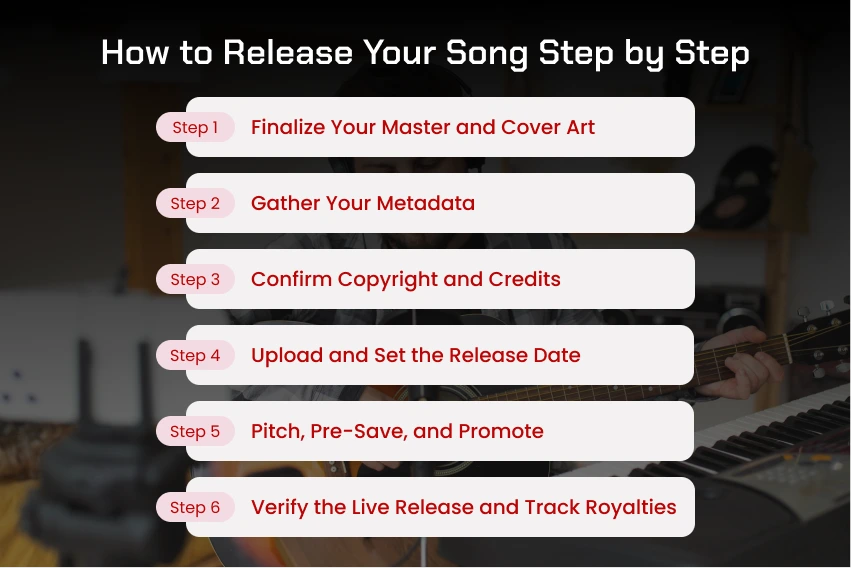
Step 1: Finalize Your Master and Cover Art
Have your mastered WAV ready, with 16-bit, 44.1 kHz as the safe default, plus square cover art at 3000 x 3000 pixels. Platforms reject low-resolution art and odd file formats, which delays your release. If JBZ Beats mastered your track, this file is already release-ready.
Step 2: Gather Your Metadata
Metadata is the information attached to your release: song title, primary and featured artist names, genre, the producer credit, your ISRC and UPC codes, and the release date. Your distributor generates the codes. Clean metadata is what keeps your song from being rejected or mismatched across platforms.
Step 3: Confirm Copyright and Credits
If you are independent, you are the artist, the label, and the copyright owner of your recording. List the producer in the songwriter and producer credits exactly as your license requires. Sort ownership out before you submit so a credit question never delays your drop.
Step 4: Upload and Set the Release Date
Upload your master, enter your metadata, select worldwide distribution, which is usually free, and set a release date at least three to four weeks out. That lead time lets you pitch to Spotify’s editorial team and run a pre-save campaign, both of which lift your first-week numbers.
Step 5: Pitch, Pre-Save, and Promote
Use Spotify for Artists to pitch your unreleased track to editorial playlists. Set up a pre-save link, line up your social posts, and tell your existing audience before launch day, not after. The release does not promote itself.
Step 6: Verify the Live Release and Track Royalties
Once your song is live, check that the credits, artwork, and audio display correctly on every platform. Then watch your distributor and PRO statements so you can catch any missing splits or payment holds early.
|
Need a Beat First? Buy Rap Beats Online at JBZ Beats Hip Hop Beats for Sale with instant downloads, clear licensing, and free mixing and mastering on every purchase. Start your next release today.
|
Conclusion
Releasing a song you made with a bought beat comes down to a simple chain: confirm your license, finalize a strong master, register to collect every royalty type, distribute through a real distributor, and credit your producer correctly. Get that chain right and your release goes live clean, monetizes fully, and holds up if your career takes off. The steps you skip do not disappear. They wait, and they surface at the exact moment your song starts working. Before you buy rap beats for your next project, set the release up properly from the license forward. Browse Rap Instrumentals for Sale at JBZ Beats and get your next track release-ready today.
FAQ
Can I release a song on Spotify if I only bought a lease?
Yes, most leases allow commercial release on streaming platforms, but check your stream and unit caps first. Basic leases often cap you around 50,000 streams or 5,000 units. If you expect your song to outperform that, upgrade to an unlimited license or buy an exclusive before release so you stay in full compliance with your agreement and avoid problems if the track gains traction.
Do I have to pay the producer royalties after I buy the beat?
Usually not as a direct payment, but the producer typically keeps the composition (publishing) rights and collects their publishing share through their own PRO. Your purchase covers your use of the recording, not the songwriting, unless your exclusive license specifically includes a publishing buyout. Read your contract to confirm exactly what you own before you release.
What do I actually need to release a song independently in 2026?
You need a finished, mastered track, square cover art at 3000 x 3000 pixels, accurate metadata, and a music distributor like DistroKid, TuneCore, or CD Baby. To collect all your royalties, also register with a PRO (ASCAP, BMI, or SESAC) and the MLC. The distributor delivers your song to every major platform from a single upload.
How long does it take for my song to go live after I upload it?
Most distributors deliver to platforms within three to five days, though you set the actual release date yourself. Plan a release date at least three to four weeks out. That lead time lets you pitch to Spotify editorial playlists and run a pre-save campaign, both of which improve your first-week streaming numbers and your chance at a playlist add.
Where can I buy beats with clear licensing for my next release?
JBZ Beats offers Rap Beats for Sale and Instrumentals for Sale with transparent licensing, instant downloads, and no hidden fees. Leases, unlimited licenses, and exclusive rights are all available, with exclusive beats starting at $99. Every purchase includes free professional mixing and mastering, which gets your next release ready faster and removes a real cost most stores leave on you.

